The Second Deformation: Sequencing Stress Relief on Chinese CNC Parts
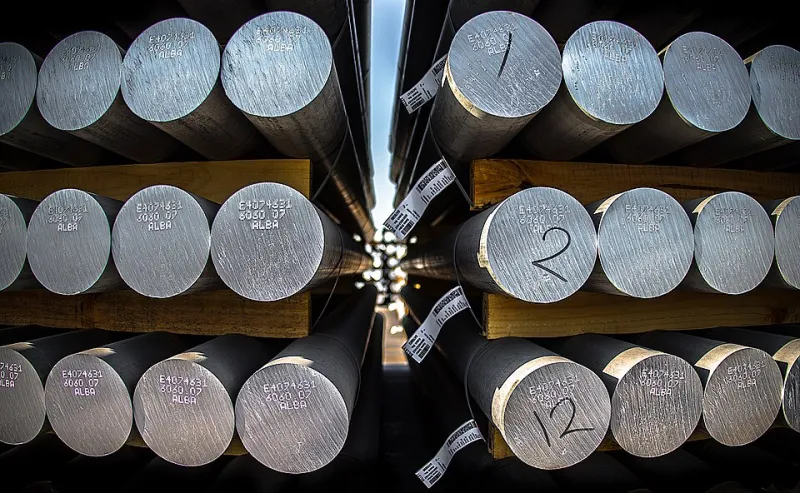
Photo: Albasmelter, CC BY-SA 4.0, via Wikimedia Commons
The part that passes and then moves
A first article report can be entirely satisfactory and still mislead. The dimensions sit inside tolerance, the surface finish meets the schedule, the inspection record is signed in the right places — and then, three weeks later, a batch of thin-walled housings is found bowing on the surface plate, or a set of brackets will no longer seat in its fixture after anodising. Nothing was machined out of tolerance. What changed was the balance of stress inside the material.
Residual stress is not a defect in the ordinary sense. It is a memory of everything the material has already been through: rolling, drawing, casting, quenching, straightening. Machining does not create that memory, but it releases it — asymmetrically, one face at a time — and the part moves to find a new equilibrium. The thinner the remaining section and the greater the proportion of material removed, the larger the movement tends to be.
For UK buyers sourcing machined parts from China, this is one of the few quality topics that cannot be resolved by inspecting the finished component. By the time the part is on a CMM in the supplier's inspection room, the movement may not yet have happened. It has to be resolved in the purchase order, before the first cut.
Where the stress comes from
The starting stock is the first variable. Aluminium plate and billet in 6082-T6 or 7075-T651 carry stress from rolling and from the quench that produced the temper. Cold-drawn bar carries stress from the drawing operation. Castings carry stress from solidification and from any subsequent straightening. None of this is visible on a mill certificate, and none of it is captured by a hardness reading.
The second variable is the machining strategy itself. A part machined symmetrically, with balanced stock removal on opposing faces, will usually distort less than one where a pocket is taken out of a single face in a single operation. This is a matter of process design rather than machine capability, and it is decided long before the spindle starts.
Why the quotation is usually silent
Chinese CNC shops quote the drawing, not the route. Stress relief is a separate operation: a furnace cycle, a queue for it, a second setup afterwards, and possibly a second inspection. Where a buyer has not asked for it, the default is to machine from stock as supplied and deliver. The absence of a stress relief line in a quotation is therefore not a refusal — it is usually an assumption that has never been tested.
The consequence is that stress relief behaves like an invisible extra. It is omitted from the price, omitted from the schedule, and omitted from the conversation until a part moves. Adding it after award is possible but expensive: it triggers a re-quote, a revised route card, and a new lead time, at a point when the buyer has least leverage.
Sequencing is the specification
It is tempting to treat stress relief as a single instruction — "relieve stress after machining" — but that instruction is close to useless. A thermal cycle applied to a finished part will release stress and then leave the part distorted with no material left to correct it. The specification that matters is where in the route the cycle sits.
The conventional sequence for a part with significant stock removal is: rough machine leaving uniform allowance, thermally relieve, then semi-finish and finish. For thin-walled or high-aspect-ratio parts, a second relief between semi-finishing and finishing is sometimes justified. The allowance left before relief must be sufficient to clean up the distortion the relief itself induces — typically 0.5 mm to 1.0 mm per face, agreed with the supplier rather than assumed.
A clause set for the RFQ
The following clauses are short enough to sit in a request for quotation without overwhelming it, and specific enough to be auditable later.
- Requirement. State that the component is subject to thermal stress relief, and that it applies to the specified part numbers and material conditions only.
- Position in the route. Specify the operation number or sequence after which relief must occur, and the allowance to be left for subsequent machining.
- Cycle parameters. Require a documented cycle with a defined ramp rate, soak temperature, soak duration and cooling method. The soak temperature must remain below any tempering or ageing temperature associated with the material's condition.
- Furnace control. Require the furnace to be instrumented and calibrated, with a stated pyrometry class where the buyer's own quality system demands one.
- Loading. Require the parts to be supported so that they do not sag during the soak, and state whether batch loading with other parts is permitted.
- Records. Require a cycle chart or data log per load, retained and supplied with the delivery documentation.
- Verification. Require dimensional check of flatness or straightness immediately after relief and again after final machining, with the results recorded on the inspection report.
- Certification. Require a stress relief certificate referencing the purchase order, part number, quantity, furnace identifier and cycle date — not a general quality certificate.
What counts as evidence
A supplier's assurance that relief has been carried out is worth very little on its own. What is worth something is a cycle chart showing the actual soak temperature and duration against the specified window, and a dimensional record taken after relief. A hardness check before and after the cycle is a useful cross-check: it will not detect stress, but it will expose a furnace that has run hot enough to alter the temper.
Where the buyer's own quality system requires it, a witness point at the relief stage can be built into the route for the first batch, with the supplier providing photographic evidence of the load and the chart. That is a far cheaper form of assurance than discovering the problem at goods-in.
When a supplier says it is not required
Some suppliers will argue that relief is unnecessary for the material or the geometry concerned. That may be true, but the claim deserves a question rather than an argument. Ask what the mill certificate states about the condition of the stock, ask to see the route card showing how many operations precede the finish pass, and ask for the supplier's own experience of distortion on comparable parts. A supplier with a genuine basis for the claim will usually have a route card and a history to point to.
A supplier without one is generally making a reasonable guess. In that case, the practical response is to price the relief rather than debate it. For most parts the cycle is a modest addition to unit cost; against the cost of scrapping a batch, reworking a fixture, or absorbing a schedule slip on a UK assembly line, it is rarely the expensive option.
The commercial argument
Specify relief at the RFQ stage, when it can be priced alongside everything else. Specify the sequence, not just the operation. Specify the evidence, not just the intent. A part that measures well on the day of inspection and moves three weeks later is not a quality failure that can be negotiated after the fact — it is a specification that was never written.