Two Suppliers, One Drawing: Qualifying a Chinese CNC Backup Without Importing a Second Interpretation
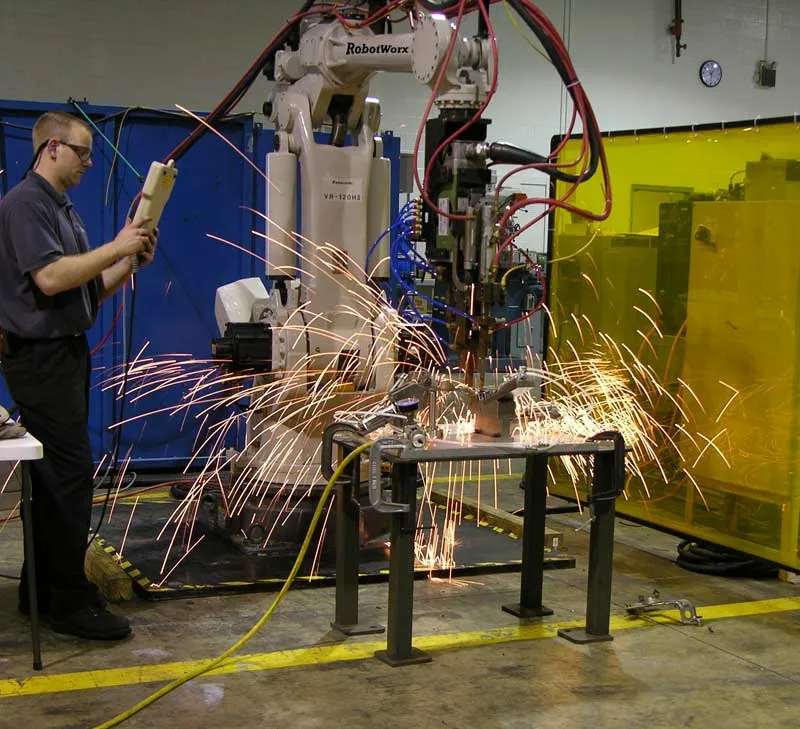
Photo: Robotworx, CC BY-SA 3.0, via Wikimedia Commons
The arithmetic that makes dual-sourcing look obvious
On paper the case is straightforward. A single Chinese machining source represents a single point of failure: a fire, a labour dispute, an unexpected capacity squeeze before Spring Festival, or a quality system that degrades after a management change. A qualified second supplier appears to cost nothing but a qualification effort and a modest price premium.
In practice, the premium is rarely the problem. The problem is that two suppliers will not read your drawing identically, and neither reading will be obviously wrong. One will interpret an unspecified corner break as R0.2 and the other as a 0.5 mm chamfer. One will treat a datuming hole as the fixture reference and the other will pick the outside profile. Both will pass their own first article. Both will be, by their own lights, correct. You will then have two variants of a part that is nominally the same part number, and no clean way to tell them apart at goods-in.
Redundancy is only worth having if it is redundancy of capacity rather than redundancy of design intent.
Why two readings emerge from one document
Chinese CNC shops are, in the main, competent and pragmatic. Given an under-specified feature, a programmer will make a decision that minimises risk on their own equipment, and that decision will be shaped by their machine park, their tooling stock, and the conventions of the drawings they most often see. This is not a defect in their approach; it is what any competent machinist does when the drawing leaves a gap.
The difficulty is that your drawing almost certainly has more gaps than you believe. Features that your incumbent supplier has quietly standardised over three years — the exact deburr, the thread relief, the surface finish on a non-critical face — are precisely the features a new supplier has no history with.
Split scope by feature criticality, not by part number
The most common dual-sourcing error is dividing the work by part or by volume share. A more reliable approach is to divide by sensitivity.
Class 1 — interface-critical. Datum features, mating bores, sealing faces, threaded interfaces, anything that touches a safety case or a customer assembly. These stay with one supplier until the second has demonstrated capability through repeated first articles, and ideally through a capability study on the specific machine that will run the work.
Class 2 — form and fit. Non-mating geometry where a small deviation is tolerable but visible or measurable, such as cosmetic surfaces on a visible face or a clearance pocket.
Class 3 — non-critical. Badge faces, cable routes, weight-relief pockets, non-functional radii.
A useful starting allocation is to give the backup supplier Class 3 and the simpler Class 2 work first, under the same drawing revision, and compare output directly against incoming inspection data from the incumbent. This produces a genuine A/B comparison on low-consequence features before the stakes rise.
Making first articles comparable across two sites
Two first article reports that use different inspection methods cannot be compared, however professional each looks. Insist on a common measurement brief issued with the order:
- The same datum scheme, stated explicitly rather than inferred from the drawing.
- The same instrument classes, with the CMM or gauge identified.
- The same sampling: every Class 1 feature measured, not sampled.
- Reporting in the same units — metric throughout, with thread callouts written out in full rather than left as an ambiguous shorthand.
- A photograph set taken at defined angles under defined lighting, so cosmetic comparisons are possible at all.
Where the two reports diverge, treat the divergence as a drawing defect until proven otherwise. In most cases it is: an under-defined feature that the incumbent had resolved in a way you never wrote down.
Revision control is the whole game
A second supplier doubles the number of sites holding a copy of your drawing, and therefore doubles the number of places a superseded revision can survive. Three habits keep this contained.
- Single issue point. Drawings reach both suppliers from one controlled source with a revision letter and an issue date on the face of the document. No email forwarding between suppliers, ever.
- Acknowledgement per revision. Each supplier confirms in writing that revision X is in force and that revision X-1 has been withdrawn from the shop floor, with the date of withdrawal.
- Change notice before shipment. For any revision issued in the preceding four weeks, require a pre-shipment confirmation that shipped parts conform to the current revision. This catches the overlap period, which is where most escapes happen.
A simple shared revision log, circulated fortnightly to both suppliers and to your own goods-in team, costs almost nothing and removes the most common cause of mixed-revision deliveries.
Contracting for the overlap
Dual-sourcing needs a small amount of contractual scaffolding that single-sourcing does not. Capacity commitments are the important one: a backup supplier who has agreed to be available but has committed to nothing will not be available when you actually need them. Agree a minimum annual volume, a defined lead time for surge orders, and a refresh cadence — run a live order through the second supplier at least once or twice a year, even when the first is performing. A dormant approved supplier is an untested supplier.
It is also worth agreeing explicitly that the second supplier will not be given access to the first supplier's fixtures, programs or setup sheets. Shared tooling is a shared failure mode and it undermines the entire point of the exercise.
When a single source remains the better answer
Dual-sourcing is not a universal good. For low-volume, high-complexity parts, or where a tight tolerance stack depends on a single fixture built around one machine, the qualification cost and the variation risk can easily exceed the resilience gained. In those cases, the better investment is depth in one relationship: a documented capacity agreement, a second machine qualified at the same site, and a genuine business continuity conversation.
The test is simple. If your second source would produce a part you could not distinguish from the first at goods-in without measurement, dual-sourcing is adding resilience. If you would need to measure to tell them apart, it is adding variation — and you have simply moved the single point of failure from capacity to interpretation.