What the Machine Reads: A Manufacturing Intent Sheet for Chinese CNC RFQs
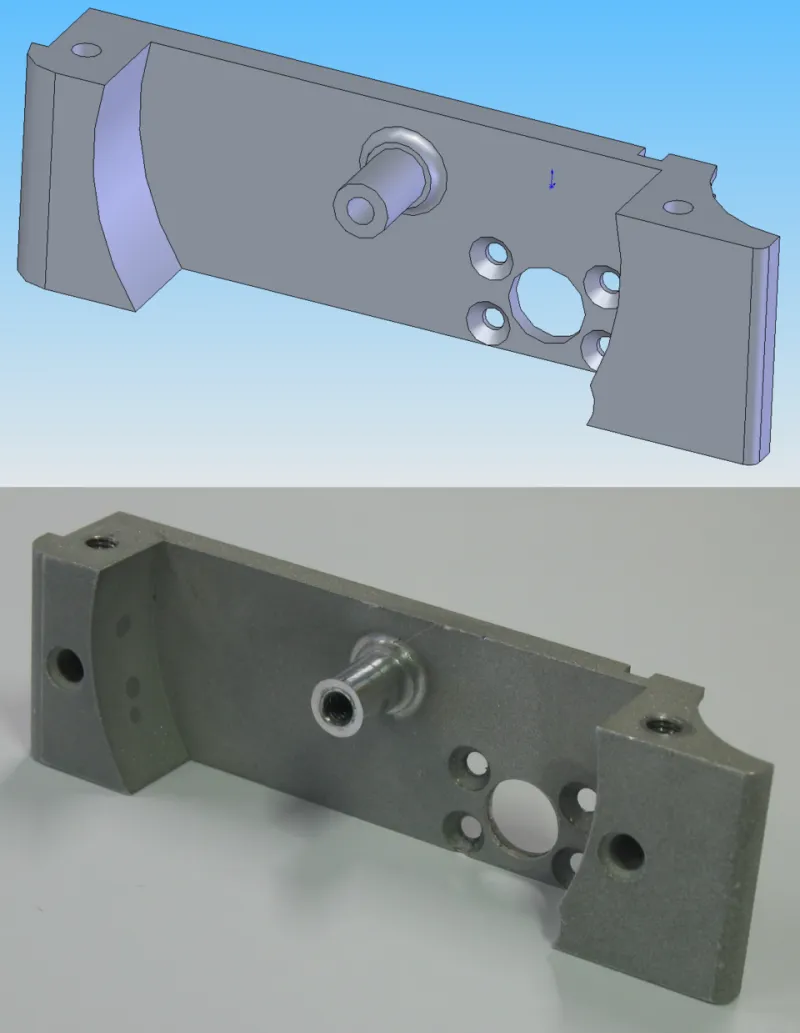
Photo: Mike1024, Public domain, via Wikimedia Commons
A drawing is a specification, not a conversation
A UK engineer issues a drawing with a title block, a general tolerance note and a handful of critical dimensions. The drawing is a precise document, but it is not a contract in the practical sense. The purchase order is. Between the two sits a Chinese machine shop that will read the geometry, the notes and the title block, and then resolve any ambiguity in the way that keeps its schedule moving. That is where design intent goes missing. A one-page manufacturing intent sheet attached to every RFQ closes much of the gap before it becomes a clarification cycle, a rework note or a rejected first article.
Where design intent goes missing
Tolerance stacking is the first casualty. A drawing may specify individual tolerances that are each achievable, yet the assembly still fails because no one has stated which dimensions control fit. General tolerance blocks are not a stack-up analysis. Mark the critical dimensions, state the mating condition and ask the supplier to report actuals on those features. If a bore and a shaft must align, say so on the sheet rather than leaving the machine operator to infer it from the drawing.
Surface finish is the second. A callout of Ra 1.6 is clear; a note saying 'fine machined finish' is not. Cosmetic anodised surfaces are especially prone to assumption. If a face will be visible on a UK product, say which faces are cosmetic, whether masking is required and what colour and sheen are acceptable. A reference photograph is often more useful than another adjective.
Material certification is the third. A UK drawing may call for 6082-T6 while the Chinese supply chain works with its own grade designations and mill certificates. Specify the certificate you need, such as EN 10204 3.1, and state that equivalent grades require written approval before production. Ask for heat numbers and mechanical properties to be included with the first article, not promised for later.
Notes are the fourth. 'Deburr all edges' and 'break sharp edges' are intentions, not process instructions. 'Do not scale' protects the drawing but tells the machine shop nothing about manufacture. Critical notes should be short, specific and, where necessary, translated into Chinese alongside the English text. A bilingual sheet is not a sign of distrust; it is a control against a operator reading a PDF in a second language at the machine.
The one-page manufacturing intent sheet
Keep the sheet to a single page and attach it to the RFQ as a controlled document. It should carry the part number and revision, the material and certificate requirement, the critical dimensions with their tolerance and stack-up note, the surface finish and cosmetic zones, any heat treatment or coating, the inspection and first article requirements, packaging expectations and the quantity or bridge-run arrangement. Add a column for supplier comments so the factory can confirm or challenge each point before quoting.
A useful entry might read: 'Dimension 24.0 +/-0.05 controls bearing fit. Do not widen to general tolerance. Measure with CMM and report actual.' That single line does more than a page of general notes because it tells the supplier what the dimension is for and how it will be verified.
Put it into the RFQ and the purchase order
The sheet only works if it travels with the commercial documents. Attach it to the RFQ, ask the supplier to return it with comments, and include the agreed version in the purchase order. If a supplier cannot meet a requirement, it should say so before the order is placed. That is the purpose of the exercise: to move disagreement upstream, where it is cheap, rather than downstream, where it is not.
Why this matters for UK buyers
Chinese CNC suppliers are often technically capable. The recurring problem is not machine capability but information asymmetry. A one-page sheet costs little to prepare and gives the supplier a clear statement of what must not be assumed. It also creates an audit trail. During a supplier audit or a first article review, you can check whether the sheet is actually used at the machine and whether the inspection report addresses the points you raised.
The drawing plus the intent
The drawing defines geometry. The manufacturing intent sheet defines the conditions under which that geometry is acceptable. Add it to every RFQ and the clarification cycle becomes shorter, the first article becomes more predictable and the assumptions move from the shop floor to the quotation stage, where a UK buyer can actually manage them.