The Invoice Is Only the Beginning: Modelling Landed Cost for Chinese CNC Parts in 2026
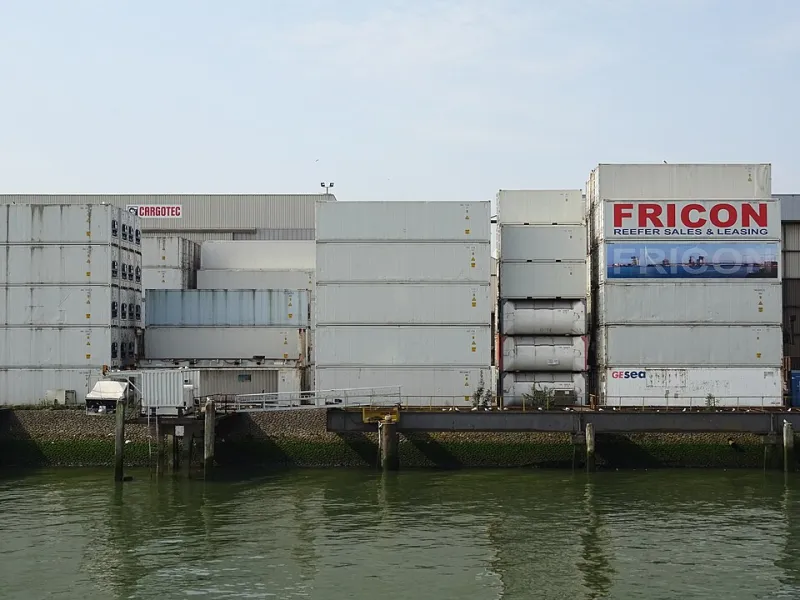
Photo: AgainErick, CC BY-SA 4.0, via Wikimedia Commons
A Chinese CNC quotation and a UK job shop quotation rarely describe the same commercial transaction. The Chinese price may be FOB Shanghai, with freight, insurance, duty and clearance excluded. The UK price may be ex-works, collection only, or delivered to the buyer’s gate. Comparing the two headline numbers is not a sourcing decision; it is a comparison of unlike things.
For 2026 budgeting, UK engineers and buyers need a landed-cost model that ends at the same point for both options: material in the stores, inspected, released to production, and with an allowance for the quality and inventory consequences of the chosen supply route. The model does not need to be elaborate, but it does need to be explicit.
Set the comparison boundary
Define the part, annual volume, batch size and delivery point before collecting prices. A useful boundary is ‘delivered to the UK factory, import cleared, incoming inspection completed and batch released’. Ask the Chinese supplier for a DAP quote as well as FOB, and ask the UK job shop for a delivered price. If either supplier cannot quote on the same basis, convert their price using documented assumptions rather than intuition.
The model should also state the planning year. For 2026, use current freight indications, the UK Global Tariff rate for the classified commodity code, a planning GBP/USD or GBP/CNY rate, and a stated inventory carrying rate. These are assumptions, not forecasts, and they should be visible so that colleagues can challenge them.
Incoterms and the point of cost transfer
Incoterms 2020 defines where cost and risk move, but it does not define landed cost. FOB means the supplier delivers on board the vessel; the buyer pays main carriage, insurance and import costs. CIF adds freight and insurance to the price, but the buyer still handles import clearance and duty. DAP usually places the goods at the UK delivery point with import clearance still to be arranged by the buyer, while DDP shifts more responsibility to the seller.
A DDP quotation can be useful, but check what it includes. If the seller’s DDP price excludes UK VAT, or uses a customs agent that undervalues the goods, the commercial risk has not disappeared. For most UK buyers, a DAP or FOB comparison with a transparent import cost build-up is easier to audit than an opaque DDP figure.
Freight, insurance and UK haulage
CNC parts are dense, so air freight is usually reserved for urgent samples or recovery shipments. Sea freight and groupage are more common for production batches, with transit times that must be reflected in inventory planning. Chargeable weight, port handling, documentation and UK port charges should be included. Add marine insurance at a stated percentage of the CIF value, and add haulage from the UK port or freight forwarder to the factory.
For small batches, an express courier may be cheaper than a formal sea consignment once minimum charges and clearance fees are counted. The model should compare freight modes at the actual batch size, not at an assumed container load.
Duty, VAT and customs clearance
Classify the part correctly. Machined metal components may attract different duty rates depending on material, function and commodity code. The UK Global Tariff should be checked for the code used on the customs entry, and the classification should be defensible if HMRC asks. Rules of origin matter: Chinese-origin goods do not generally receive preferential UK access, so the duty rate applies unless a specific relief is available.
Import VAT is usually recoverable for VAT-registered UK businesses, but it is still a cash-flow item. Postponed VAT accounting can ease the cash burden, but the cost must appear in the model. Customs agent fees, deferment charges and any inspection or exam fees should be added. A typical clearance fee may be modest per entry, but frequent small shipments multiply it.
Currency movement
Chinese suppliers often quote in USD, while UK costs are in GBP. A 2026 sourcing model should convert at a documented planning rate and add a contingency for movement between quotation and payment. For a 90-day order cycle, a small percentage change in GBP/USD can erase a negotiated price reduction. If the annual spend is material, consider forward cover or a currency clause. If not, at least show the sensitivity: what happens to landed cost if sterling weakens by three or five per cent?
Inspection and rework risk
Incoming inspection is a real cost, not an overhead that can be ignored. Add the cost of sample inspection, third-party pre-shipment inspection where used, and any destructive testing. Then add an expected rework or scrap allowance. This is not a slur on Chinese suppliers; it is a recognition that a longer supply chain makes containment harder. If historical data show a two per cent reject rate and a £40 average rework cost per rejected part, the expected cost per part is £0.80 before any line-stoppage impact.
Inventory carrying cost
Longer lead times require more inventory. If sea freight adds 30 days to the replenishment cycle compared with a UK job shop, the buyer carries roughly an extra month of stock. Use a carrying rate that includes capital, storage, insurance, handling and obsolescence. A rate of 20 to 30 per cent per annum is a reasonable planning range, but state the figure used. The calculation is simple: average additional inventory value multiplied by the annual carrying rate, prorated for the extra days.
A worked comparison
Consider an illustrative machined bracket with an annual volume of 500 parts, ordered in batches of 500. The Chinese supplier quotes £10.00 per part FOB, giving £5,000. Sea freight and insurance add £1,600. The CIF value is £6,600. Assume duty at 2 per cent, or £132, clearance at £60 and UK haulage at £350. Incoming inspection is £600 and the expected rework allowance is £400. The landed cost before VAT is £8,142, or £16.28 per part.
Import VAT at 20 per cent on £8,142 is £1,628.40. If the buyer uses postponed VAT accounting, this is a cash-flow entry rather than an absolute cost, but it still belongs in the budget. Add inventory carrying cost for an extra 30 days at 25 per cent per annum: £8,142 × 0.25 × 30/365, or about £167, giving £16.62 per part.
The UK job shop quotes £18.00 per part delivered, or £9,000 for the batch. Add £200 for incoming inspection and the UK landed cost is £9,200, or £18.40 per part. On these assumptions, the Chinese route is cheaper by £1.78 per part. Change the freight to air, or reduce the batch to 100 parts, and the conclusion may reverse. That is the point of the model.
Negotiating from a defensible baseline
A landed-cost model gives UK buyers a better negotiating position with both sides. With the Chinese supplier, the discussion can focus on DAP terms, consolidation, packaging density and batch size. With the UK job shop, the comparison can recognise the value of shorter lead times and lower inventory. Neither conversation should be conducted on piece price alone. In 2026, the defensible number is the one that reaches the stores, cleared, inspected and released.