Clamped, Not Confirmed: Reviewing Workholding Strategy Before a Chinese CNC Award
The gap between the drawing and the vice
A Chinese CNC quotation typically arrives with a machine list, a tolerance statement, a material specification and a price. It rarely explains how the part will be held. For straightforward prismatic components, that omission is usually harmless. For thin-walled housings, asymmetric brackets, long slender shafts or parts with interrupted surfaces, it is a material gap in the process definition.
The machine tool is visible and therefore audited. The drawing is contractual and therefore reviewed. The fixture sits between them, often designed after the order is placed and rarely examined by the UK buyer until a first article report shows a problem. By then, the supplier may have proved a process that is stable only under one clamping pressure, one operator or one order quantity.
Workholding is not a secondary detail. It determines where the part is located, how it is supported, how much force it sees and how the datum is transferred from one operation to the next. Those choices can move a feature without changing the programme. A pre-award review should therefore treat the fixture as a process variable in its own right.
Why the quotation stays quiet about fixtures
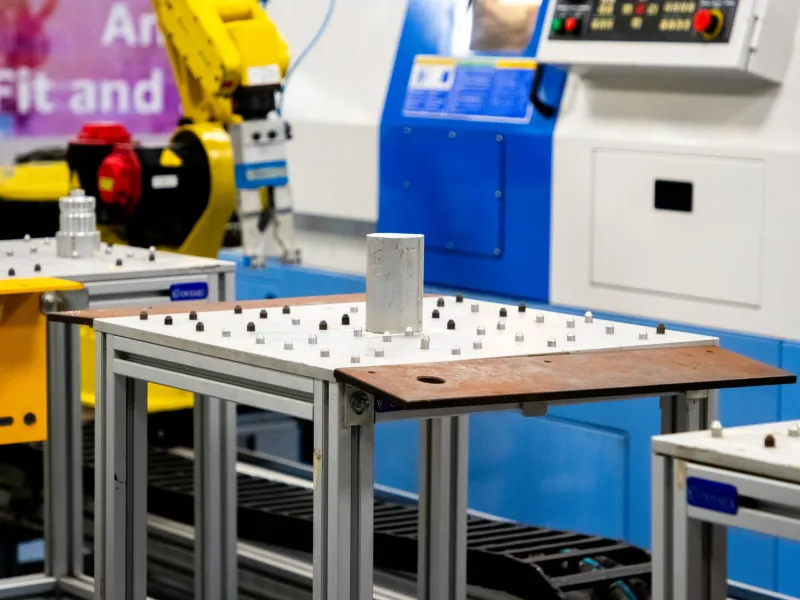
There are commercial and technical reasons for the silence. Fixture design is often priced as a separate engineering activity or absorbed into the first-order cost. Suppliers may use modular systems, soft jaws, custom plates or existing tombstone arrangements, and the choice may not be settled until the order is confirmed. Some quotations assume a generic three-jaw chuck or machine vice because the part appears simple on screen.
That assumption is reasonable only if the buyer has tested it. A part with a 1.5 mm wall may be perfectly machinable in a vice, but only with controlled clamping pressure, sequenced material removal and a support strategy that changes as the wall thins. A part with an asymmetric footprint may sit flat in CAD and lift under clamping. A part with a datum on a machined face may be located from a rough surface in operation one and from a finished surface in operation two, introducing a shift that the drawing does not anticipate.
The buyer does not need to design the fixture. The buyer does need to know whether the supplier has recognised these issues before the purchase order removes the incentive to discuss them.
Distortion is a process decision, not a material property
Thin-walled parts are frequently described as prone to distortion, as though the material were at fault. In practice, distortion is a conversation between residual stress, clamping force, support conditions and the sequence of cuts. Two suppliers can machine the same drawing on comparable machines and achieve different results because one controls those variables and the other does not.
A useful pre-award question is therefore not “Will the part distort?” but “How will you know, and what will you change if it does?” Suppliers who have a considered answer will usually describe support behind the wall, light clamping, sympathetical material removal, stress-relieving before finish machining, or a deliberate semi-finish stage. Suppliers without one may simply state that the part is “easy” or that their machinists are experienced.
For asymmetric parts, the relevant issue is often datum shift rather than visible distortion. Clamping can rotate or lift the part by a small amount that is invisible on the bench but significant at a bore or a mounting face. If the first operation establishes a datum from a surface that moves under clamping, every subsequent operation inherits that movement.
Multi-operation handover is where assumptions accumulate
Most CNC parts are not made in one operation. The first operation creates a reference; the second uses it. The fixture strategy for operation one may be entirely different from operation two, and the handover between them is a common source of drift.
Ask the supplier to describe the locating scheme for each operation in plain terms: which surfaces locate, which surfaces clamp, and which surfaces are machined. Then ask how the part is supported when the clamping force is applied. A fixture that locates on three pads and clamps over an unsupported span is a different proposition from one that clamps directly over the locating points.
This is particularly important where the drawing defines a datum on a face that is not present in the raw material. If operation one machines that face, operation two can locate on it. If operation one clamps on it before machining, the datum may be influenced by the clamping condition. The supplier should be able to explain the sequence without referring only to the CAM programme.
What to request before award
A proportionate review does not require a full fixture design package for every order. It requires enough evidence to judge whether the supplier has engaged with the part. For thin-walled, asymmetric or multi-operation components, the following requests are reasonable:
- A short written description of the workholding concept for each operation, including locating surfaces, clamping surfaces and support conditions.
- Confirmation of whether custom fixtures, soft jaws or modular systems are intended, and whether fixture cost and lead time are included in the quotation.
- The proposed sequence for stress relief, semi-finishing and final finishing where distortion risk is material.
- The method for proving the first off, including which features will be measured, on which datum, and whether the part will be measured free or clamped.
- A named point of contact for fixture-related changes, so that a supplier-initiated alteration does not pass unnoticed into production.
For lower-risk parts, a short statement may be sufficient. The audit should be proportionate to the consequence of failure, not applied uniformly to every bracket and spacer.
Proving the first off, not just inspecting it
First-off approval is often treated as a dimensional event: the report arrives, the features are compared with the drawing, and production is released. That is necessary but incomplete. The first off should also confirm that the workholding strategy produces a part that is representative of the batch.
Ask whether the first-off part was measured in the fixture, free on a surface table, or both. A part that measures correctly while clamped may relax when released. A part that measures correctly free may be difficult to reproduce if the operator relies on a particular clamping pressure. The difference matters for thin walls and for any feature that is sensitive to residual stress.
It is also worth asking how the supplier will detect drift during production. If the fixture relies on operator feel, a pressure gauge or a torque setting, that reliance should be visible in the control plan. If the fixture is designed for one part and the order moves to a second batch, the buyer should know whether the same fixture will be used and whether it will be re-proved.
A small question with a long reach
The workholding audit is not an attempt to design the supplier’s process from the UK. It is a check that the process has been thought through before the commercial pressure of a live order makes challenge harder. A supplier who can explain how the part is located, supported and released is more likely to control distortion and datum shift than one who answers only with machine specifications.
For UK buyers sourcing CNC parts from China, the fixture is often the least visible element of the quotation and one of the most influential. Asking about it before award is a modest intervention. Leaving it unasked is an assumption that the part will be held as carefully as it was quoted.